Which Lifting Device Has the Least Downtime?
Mijan Mijan • October 1, 2026
Introduction
If you are traveling to Seoul for a non-surgical lifting treatment, downtime can be just as important as the lifting effect. You may have only a few days in Korea and still want to visit restaurants, shop, attend meetings, or fly home shortly after treatment.
The good news is that most modern non-surgical lifting treatments have relatively limited downtime compared with surgery. However, “little downtime” does not mean zero visible reaction, and the recovery period varies by device, treatment intensity, treatment area, and individual sensitivity.
Among commonly discussed options such as HIFU, Ultherapy, Shurink, Thermage, Oligio, and Sofwave, the appropriate choice depends not only on recovery time but also on what type of laxity you are trying to treat.
What Counts as Downtime After a Lifting Treatment?
Downtime can mean different things to different patients.
For some people, downtime means being unable to work. For others, it means any redness, swelling, tenderness, bruising, or facial sensitivity that is noticeable to other people.
For a medical-tourism trip, it is useful to think about downtime in three categories:
- Functional downtime: when you cannot comfortably continue normal activities.
- Visible downtime: when redness, swelling, or bruising may be noticeable.
- Treatment sensitivity: when the skin or treated area remains tender even though you can function normally.
A treatment can therefore have almost no functional downtime while still producing temporary tenderness or swelling.
Which Lifting Treatments Usually Have Limited Downtime?
Non-invasive energy-based lifting treatments generally involve substantially less recovery than surgical facelifts.
HIFU and microfocused ultrasound have been associated with temporary redness, swelling, tenderness, and discomfort, but these reactions are generally short-lived in clinical studies. (pubmed.ncbi.nlm.nih.gov)
RF treatments can similarly produce temporary redness, swelling, tenderness, or sensitivity depending on the technology and treatment intensity. A systematic review of RF for skin laxity found generally favorable safety findings, although individual devices and protocols differ. (pubmed.ncbi.nlm.nih.gov)
HIFU and Microfocused Ultrasound
HIFU and microfocused ultrasound are often selected when patients want tightening without a surgical recovery period.
Typical reactions can include:
- temporary redness
- swelling
- tenderness
- sensitivity
- discomfort when touching the treated area
Some patients have little visible reaction, while others experience more noticeable tenderness or swelling.
Thermage and Other RF Treatments
RF-based treatments such as Thermage are also commonly used when minimal downtime is important.
Depending on the device and settings, patients may experience temporary redness or swelling. Some may have tenderness that lasts longer than the visible redness.
RF treatment does not necessarily produce peeling or the type of surface recovery associated with ablative laser resurfacing.
Sofwave
Sofwave is designed as a non-invasive ultrasound-based skin-tightening treatment and is generally associated with limited recovery.
Temporary redness, swelling, tenderness, or sensitivity can still occur, so it should not automatically be considered completely downtime-free.
HIFU vs RF: Which Has Less Downtime?
There is no reliable universal rule that one entire category always has less downtime than the other.
The actual recovery depends on:
- device
- energy level
- treatment density
- number of treatment lines or pulses
- treatment area
- skin sensitivity
- clinician technique
- whether multiple procedures are performed during the same visit
A conservative treatment on one device may produce less visible reaction than an aggressive treatment on another.
Treatment typeTypical recovery profilePossible temporary reactionsHIFUUsually limitedRedness, tenderness, swelling, sensitivityUltherapyUsually limitedRedness, swelling, tenderness, discomfortShurink/HIFU platformsUsually limitedRedness, tenderness, swellingThermage/RFUsually limitedRedness, swelling, tendernessOligio/RFUsually limitedTemporary redness or sensitivitySofwaveUsually limitedRedness, swelling, tendernessAblative laserMore substantialPeeling, crusting, redness, longer visible recoverySurgical faceliftSubstantially longerSwelling, bruising, incision recovery
The table describes general recovery patterns, not a guaranteed timeline for an individual treatment.
Is HIFU Completely Downtime-Free?
No.
HIFU is frequently described as having little or no downtime, but that phrase can be misleading if interpreted as “nothing will happen afterward.”
Clinical reviews report temporary erythema, edema, pain, and sensory changes among possible adverse effects. Most are transient, but the experience varies between patients. (pubmed.ncbi.nlm.nih.gov)
You may be able to continue normal activities immediately, while still experiencing tenderness when washing your face or touching the treated area.
Does Ultherapy Have Downtime?
Ultherapy is a microfocused ultrasound treatment designed to deliver focused energy at selected depths beneath the skin.
Clinical literature describes temporary redness, swelling, discomfort, and tenderness as possible reactions. In most cases, these do not require the prolonged recovery associated with surgery or aggressive resurfacing. (pubmed.ncbi.nlm.nih.gov)
However, individual recovery can differ, particularly when larger areas or more intensive treatment protocols are used.
What About Thermage?
Thermage uses radiofrequency energy rather than ultrasound.
RF treatments generally do not create the peeling or open-skin recovery associated with ablative resurfacing. A systematic review of RF treatments for skin laxity reported improvement in skin appearance with generally acceptable adverse-event profiles across the reviewed literature. (pubmed.ncbi.nlm.nih.gov)
Temporary redness, swelling, tenderness, and sensitivity can nevertheless occur.
What About Sofwave?
Sofwave uses ultrasound energy to target the mid-dermal layer for skin remodeling and tightening.
Published reviews of ultrasound-based skin rejuvenation describe ultrasound devices as generally having minimal recovery compared with invasive procedures, although temporary reactions can occur. (pubmed.ncbi.nlm.nih.gov)
For someone planning sightseeing immediately after treatment, the important question is not only whether there is technically “downtime,” but whether your face is likely to look or feel different for the rest of the day.
What Has Less Downtime: Lifting or Laser Treatment?
This depends heavily on the laser.
A non-ablative laser can have relatively little recovery, while fractional CO2 laser resurfacing can produce substantial redness, swelling, peeling, and visible skin recovery.
This distinction is important for travelers because “laser treatment” and “lifting treatment” represent very broad categories.
If your priority is minimal visible recovery, you should ask the clinic exactly what the skin is expected to look like over the following several days rather than relying only on the treatment name.
What About RF Microneedling?
RF microneedling is different from non-invasive RF.
Microneedling creates controlled skin punctures while delivering RF energy into the tissue. Because the skin is mechanically penetrated, visible redness and swelling can be more noticeable than after a completely non-invasive RF treatment.
RF microneedling can be useful for concerns such as acne scars, pores, texture, and certain types of laxity, but it should not automatically be grouped with zero-downtime lifting devices.
Which Treatment Is Most Convenient for a Short Seoul Trip?
If you only have a few days in Seoul, treatment planning should consider both recovery and the timing of your activities.
For example:
Day 1: consultation and treatment
Day 2: gentle sightseeing and normal activities if comfortable
Day 3: regular sightseeing, depending on your individual reaction
Final day: flight home if your clinician considers travel appropriate
This is only an example. Your actual schedule should be based on the treatment performed and your clinician's aftercare instructions.
Can I Go Sightseeing Immediately After a Lifting Treatment?
Often, patients can resume normal activities after non-invasive lifting procedures, but this does not mean every activity is advisable immediately.
After treatment, a clinician may recommend temporarily avoiding activities that increase heat, irritation, or pressure on the treated area.
Depending on the procedure, this can include:
- intense exercise
- saunas
- very hot baths
- excessive heat exposure
- aggressive facial massage
- irritating skincare products
Follow the specific aftercare instructions provided by your treating clinic because recommendations vary between technologies.
Can I Wear Makeup After a Lifting Treatment?
For completely non-invasive treatments, makeup may sometimes be possible relatively soon afterward.
However, if the skin is irritated, unusually sensitive, swollen, or has been treated with another procedure during the same appointment, your clinician may recommend waiting.
The safest approach is to ask the clinic before treatment if you have an event, photoshoot, wedding, or business meeting scheduled immediately afterward.
Does More Downtime Mean a Better Result?
Not necessarily.
Downtime is not a reliable measure of treatment effectiveness.
A non-invasive treatment can produce meaningful improvement with little recovery, while a more aggressive procedure may produce greater visible skin disruption without necessarily being the right treatment for your specific concern.
The goal should be an appropriate balance between expected benefit, risk, recovery, and your treatment objective.
What If I Have a Thin Face?
Downtime should not be the only consideration if you have a thin face.
You should also discuss whether the treatment is intended primarily for tightening or whether the protocol may influence facial volume.
Some ultrasound and RF protocols have been investigated for contouring or tissue-volume reduction, so the treatment plan should be individualized when preserving facial fullness is important. (pubmed.ncbi.nlm.nih.gov)
Tell the clinician clearly if you want:
“Tighter skin without making my face look thinner.”
What If I Have a Heavy Lower Face and Jowls?
If the lower face is heavy because of skin laxity, a lifting device may be appropriate.
But if the heaviness is primarily caused by localized fat or masseter muscle prominence, a tightening treatment may not directly address the underlying issue.
This is why choosing a device solely because it has minimal downtime can lead to an inappropriate treatment plan.
The first question should remain:
What is causing the lower-face heaviness?
How to Minimize Downtime Before Your Seoul Trip
You cannot guarantee a completely reaction-free recovery, but you can make the planning more predictable.
Avoid scheduling treatment immediately before an important event
If you have a wedding, professional photos, presentation, or major social event, leave some flexibility between treatment and the event.
Tell the clinic about your travel schedule
If you are flying home shortly after treatment, tell the clinician when your flight is scheduled.
Avoid stacking multiple procedures without discussing recovery
Combining several treatments may increase the likelihood of redness, swelling, tenderness, or other temporary reactions.
Plan gentle activities afterward
If possible, leave the most physically demanding or heat-intensive activities for another day.
Questions to Ask a Seoul Clinic About Downtime
Before booking, ask:
- How long will my face feel tender?
- How long could redness or swelling last?
- Will there be visible marks?
- Can I wear makeup afterward?
- Can I exercise the next day?
- Can I use my normal skincare products?
- When can I have a facial or massage?
- When is it reasonable to fly home?
- What symptoms should make me contact the clinic?
- Does combining this treatment with another procedure increase recovery time?
The Bottom Line
Most non-surgical lifting devices have relatively limited downtime, but none should automatically be described as completely recovery-free.
HIFU, Ultherapy, Thermage, Oligio, and Sofwave can all produce temporary redness, swelling, tenderness, or sensitivity depending on the treatment and individual response.
If downtime is your main concern, ask about the expected visible reaction and functional recovery, not simply whether a treatment is marketed as “no downtime.”
And if you are visiting Seoul for only a few days, plan the treatment around your itinerary rather than assuming you will look completely unchanged immediately afterward.
FAQs About Lifting Treatment Downtime
Which lifting treatment has the least downtime?
Non-invasive HIFU, MFU, RF, and ultrasound-based treatments generally have limited downtime compared with surgery or ablative resurfacing. However, there is no single device that guarantees the least recovery for every patient.
Can I work immediately after HIFU?
Many patients can return to normal activities quickly, but temporary tenderness, swelling, or redness may occur. If your appearance is particularly important for work, allow some flexibility.
Can I fly after a lifting treatment in Seoul?
Some patients can fly relatively soon after non-invasive treatments, but the appropriate timing depends on the procedure, your reaction, and the clinician's assessment. Tell the clinic your flight schedule before treatment.
Is Thermage completely downtime-free?
Thermage generally has limited downtime compared with surgical procedures, but temporary redness, swelling, tenderness, or sensitivity can occur.
Does RF microneedling have more downtime than Thermage?
RF microneedling generally causes more visible skin reaction because needles penetrate the skin. Thermage is non-invasive, so its recovery profile is different.
Can I go sightseeing after HIFU?
Many people can continue normal activities after HIFU, but intense exercise, significant heat exposure, and other activities may need to be limited temporarily depending on your clinician's instructions.
Only have time for one laser treatment in Seoul? Learn how to prioritize your main concern, compare devices, assess downtime, and plan safely.
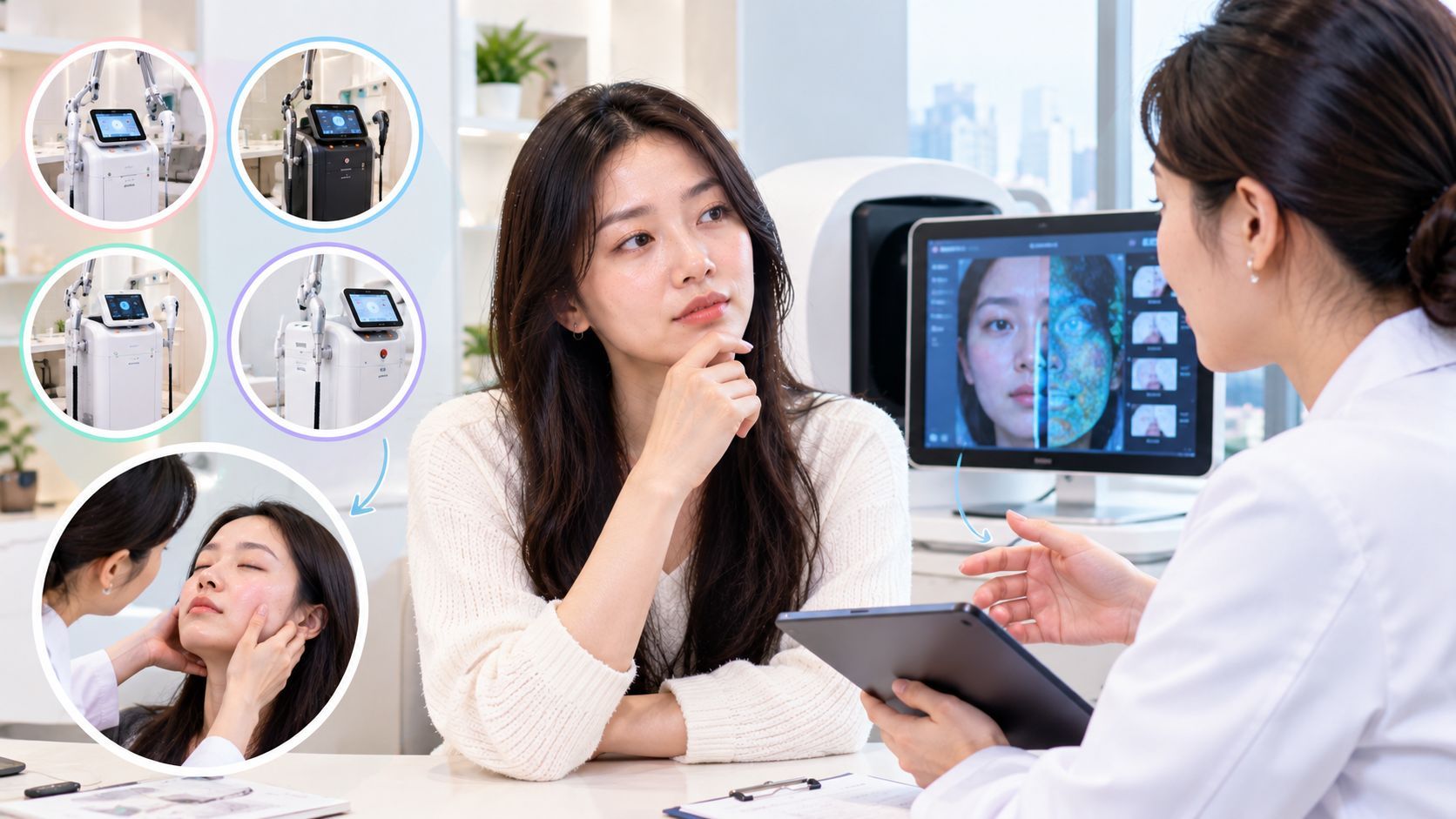
Should you choose a laser device before your Seoul treatment? Learn why skin examination, treatment goals, settings, downtime, and risks matter.
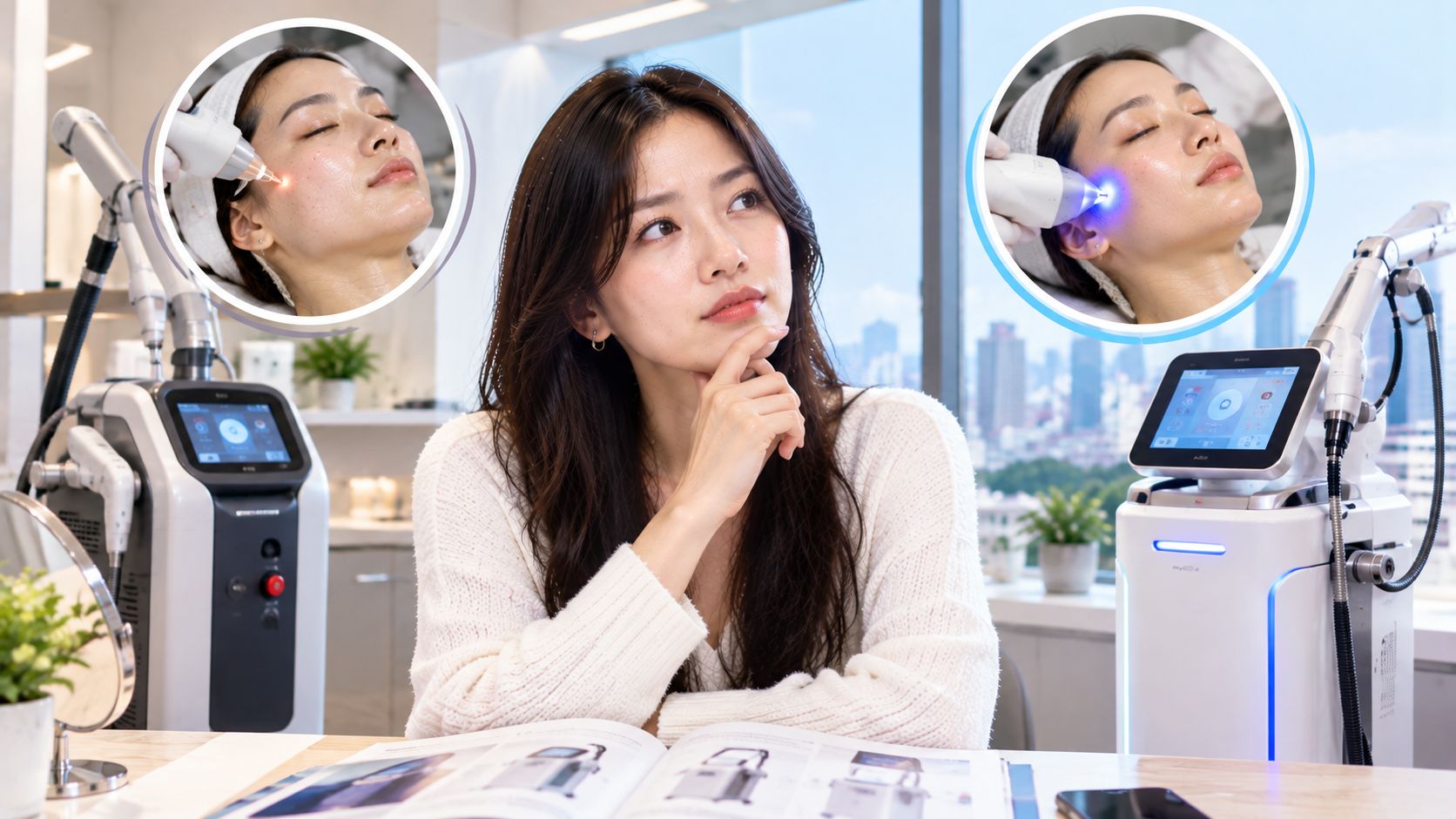
Does the newest laser machine mean better results in Seoul? Learn how to compare new and established devices by treatment goals, settings, risks, and downtime.
Choosing a Seoul laser clinic? Learn how to compare clinics when they use different machines, based on treatment goals, doctors, settings, recovery, and follow-up.
Should you do your strongest laser at the beginning or end of a Seoul trip? Learn how downtime, recovery, follow-up, and flights affect timing.
Learn which laser, RF, lifting, resurfacing, and injectable treatments may need careful spacing during a Seoul skin treatment trip.
Can you combine Pico, Potenza and a lifting treatment in Korea? Learn how to plan treatments, recovery, timing, and your Seoul trip.
Should you choose one expensive device or several cheaper lasers in Seoul? Compare cost, treatment goals, downtime, recovery, and overall value.
Have $1,000 and five days in Korea? Learn which laser and device treatments may fit your skin goals, budget, downtime, and travel schedule.
Have $500 for laser treatments in Seoul? Learn how to prioritize treatments by skin concern, downtime, value, and realistic treatment goals.