Can Laser Completely Remove Acne Scars?
Acne scars can remain long after active acne has disappeared, and laser treatment is often promoted as a way to improve them. But an important question is whether laser can completely remove acne scars.
The short answer is usually no. Laser treatment can make many acne scars less noticeable, improve uneven texture, soften scar edges, and create a smoother overall appearance. However, established acne scars are structural changes in the skin, and no laser can reliably guarantee that every scar will disappear completely.
The type, depth, shape, skin tone, and cause of the scar all influence how much improvement is possible.
What Does Laser Actually Do to Acne Scars?
Laser treatment works by delivering controlled energy into the skin. Depending on the laser, this can remove microscopic columns of damaged skin, stimulate collagen remodeling, or target specific pigment and texture concerns.
For atrophic acne scars, the goal is generally to make the scar shallower and less visible, rather than literally erase the scar tissue.
This distinction is important.
A deep depression may become smoother after treatment, but the original skin structure may not be restored exactly as it was before acne.
Laser Can Improve Several Features of Acne Scars
Depending on the device and treatment plan, laser treatment may improve:
- Uneven skin texture
- Shallow depressions
- Scar edges
- Overall skin smoothness
- Some discoloration around scars
- The contrast between scarred and normal skin
- Collagen remodeling in treated areas
The degree of improvement varies considerably between patients.
Why Can't Laser Completely Remove Every Acne Scar?
Acne scars are not all the same. Different scar types involve different structural changes beneath the skin.
A laser primarily works through controlled thermal or light-based treatment of the skin. It does not necessarily correct every underlying structural problem.
Ice-Pick Scars
Ice-pick scars are narrow but can extend relatively deeply into the skin.
A resurfacing laser may improve the surrounding texture, but a very deep, narrow scar may not respond sufficiently to broad laser resurfacing alone.
Some patients may instead be evaluated for techniques such as TCA CROSS or punch-based procedures, depending on the scar.
Rolling Scars
Rolling scars are usually wider depressions with relatively soft edges. Some are also caused by fibrous bands pulling the skin downward.
In these cases, laser can improve the surface, but it cannot necessarily release the underlying tethering.
Subcision may therefore be considered when tethering is an important part of the scar.
Laser or RF microneedling may then be used for residual textural irregularity.
Boxcar Scars
Boxcar scars have more defined edges and can be shallow or deep.
Shallow boxcar scars may respond to resurfacing treatments, while deeper scars may require a different or combined approach.
Depending on their characteristics, options can include fractional laser, RF microneedling, punch techniques, or staged combination treatment.
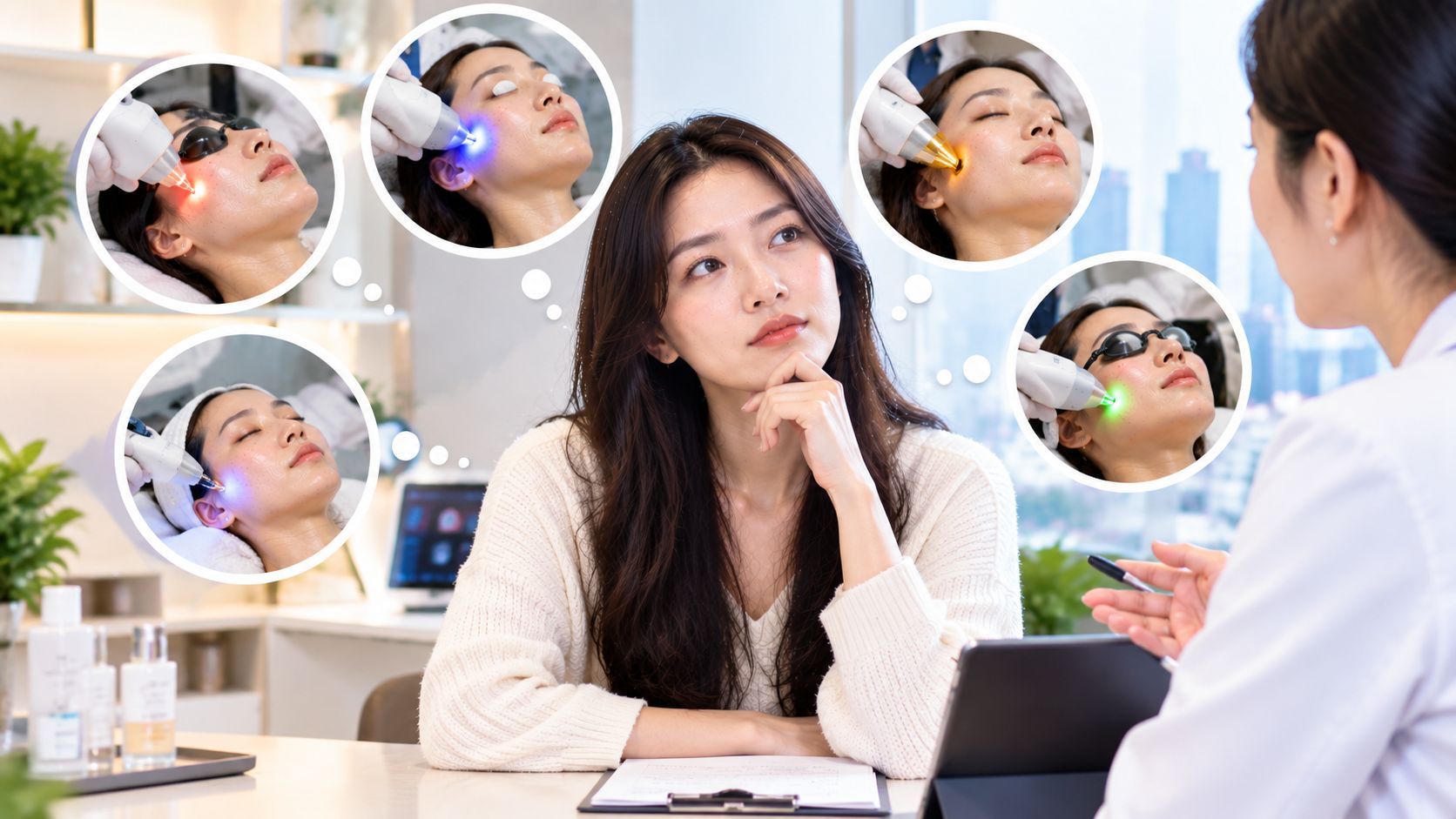
Which Lasers Are Used for Acne Scars?
There is no single laser that works for every type of acne scar.
Fractional CO₂ Laser
Fractional CO₂ is an ablative resurfacing treatment that creates controlled microscopic treatment zones in the skin.
It can be useful for certain atrophic scars and textural irregularities, particularly when more substantial resurfacing is appropriate.
However, it generally involves more recovery than gentler non-ablative approaches.
Potential effects include redness, swelling, peeling, crusting, and temporary sensitivity.
Fractional Non-Ablative Laser
Non-ablative fractional lasers heat deeper skin layers without removing the same amount of surface tissue as ablative resurfacing.
They may offer a different balance between improvement and downtime.
However, several treatments may be needed, and results can be more gradual.
Er:YAG Laser
Fractional Er:YAG can also be used for resurfacing and collagen remodeling.
Its suitability depends on scar characteristics, treatment settings, skin type, and the amount of resurfacing considered appropriate.
RF Microneedling
RF microneedling is not a laser, but it is frequently considered alongside laser treatment for acne scars.
It delivers radiofrequency energy through microneedles into selected skin depths.
For some patients, it may be useful when the goal is collagen remodeling with a different recovery profile from ablative laser resurfacing.
Pico Laser
Pico technology can have a role in selected textural and pigmentation concerns, depending on the specific device and treatment mode.
It should not automatically be considered a replacement for treatments designed specifically for deeper atrophic scars.
Does a Stronger Laser Mean Better Acne-Scar Removal?
Not necessarily.
A more aggressive treatment can produce more substantial resurfacing, but it can also involve greater downtime and a higher risk of unwanted effects.
Treatment needs to be matched to:
- Scar depth
- Scar type
- Skin tone
- Pigmentation tendency
- Active acne
- Previous treatments
- Desired recovery time
- Overall treatment goals
For example, treating a shallow scar with unnecessarily aggressive resurfacing may provide little additional benefit while increasing recovery and risk.
The objective is not simply to choose the strongest available device. It is to choose an appropriate treatment strategy for the actual scar pattern.
How Many Laser Treatments Are Needed?
There is no universal number of sessions.
One treatment may produce a visible improvement in some patients, particularly when the scars are relatively shallow and the treatment is appropriately selected.
However, acne scars frequently require multiple sessions or staged treatment.
Collagen remodeling also takes time. The skin may continue changing for weeks or months after treatment, depending on the procedure.
If multiple scar types are present, treatment may also be divided into stages rather than attempting to correct everything during one session.
A dermatologist may recommend reassessing the skin after healing before deciding whether another treatment is appropriate.
What If Laser Doesn't Fully Correct My Scars?
Incomplete improvement does not necessarily mean the treatment failed.
Some scars simply require a different technique because of their structure.
For example:
- Deep ice-pick scars: may require targeted treatment such as TCA CROSS or punch techniques.
- Tethered rolling scars: may benefit from subcision.
- Deep boxcar scars: may require scar-specific or combination procedures.
- Surface texture: may respond to fractional laser or RF microneedling.
- Pigmentation around scars: may require a separate pigmentation-focused strategy.
This is why a scar assessment is often more useful than choosing a device based only on its reputation or intensity.
Can Laser Make Acne Scars Worse?
Complications are possible with any resurfacing procedure.
Depending on the treatment, possible side effects include:
- Redness
- Swelling
- Burning or sensitivity
- Peeling or crusting
- Temporary darkening
- Post-inflammatory hyperpigmentation
- Hypopigmentation
- Prolonged redness
- Infection
- Burns or scarring in uncommon cases
People with melanin-rich or darker skin can still undergo laser treatment, but treatment parameters and the risk of post-inflammatory pigmentation need careful consideration.
Recent tanning, a history of pigmentation problems, and previous reactions to procedures should also be discussed during consultation.
Should Active Acne Be Treated First?
Often, yes.
If new inflammatory acne continues to appear, treating the scars alone may not address the underlying problem.
New acne can create additional inflammation and potentially lead to additional scarring.
A dermatologist may therefore recommend controlling active acne before beginning an intensive scar-resurfacing program.
This does not mean every patient must have perfectly clear skin before any scar treatment. The appropriate timing depends on the severity and activity of the acne.
What Should International Patients Know About Acne-Scar Laser Treatment in Seoul?
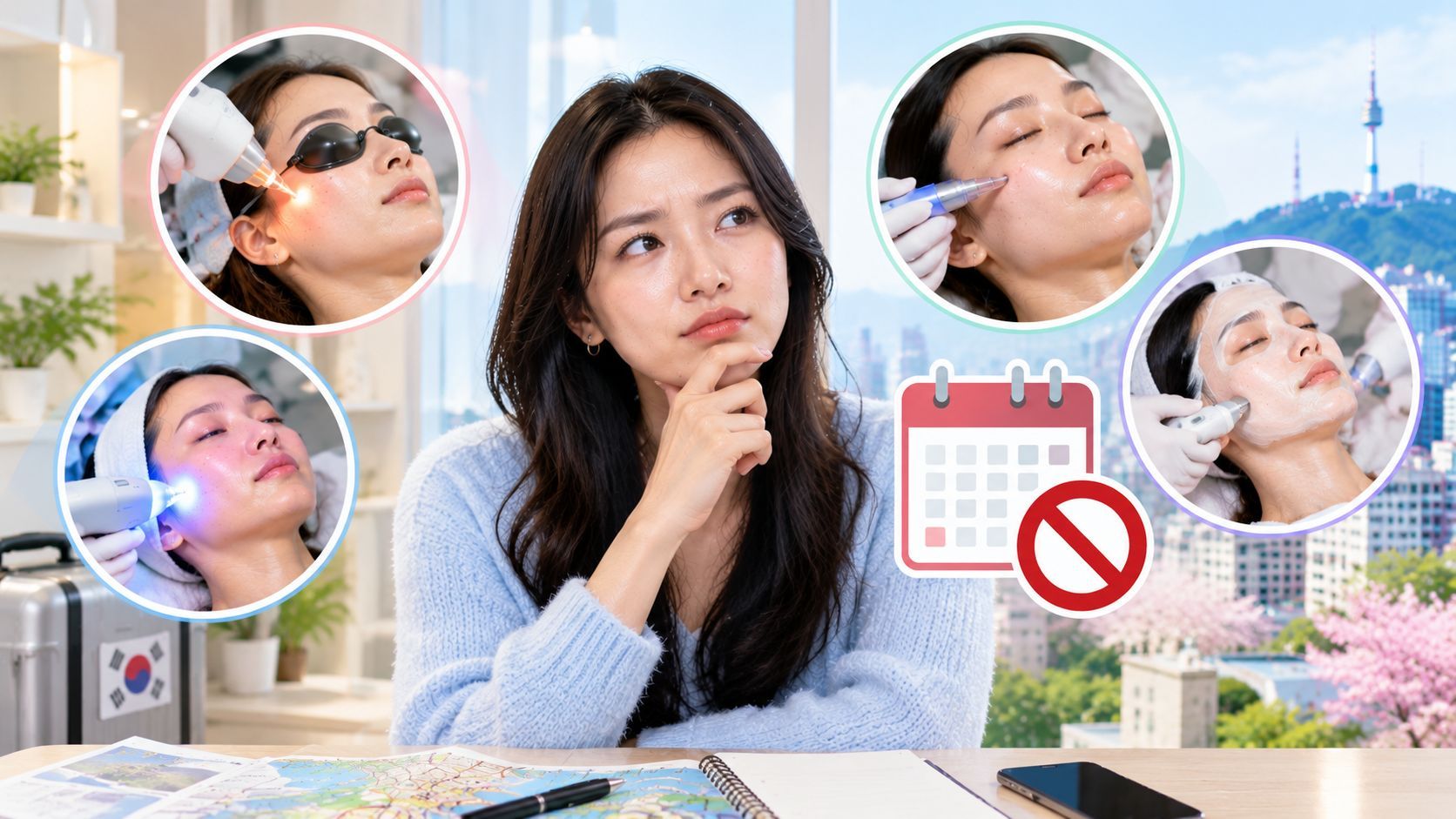
If you are traveling to Seoul specifically for acne-scar treatment, recovery time should be part of the planning process.
A short trip may not allow enough time for significant redness, peeling, or swelling to completely settle after an aggressive resurfacing procedure.
Before booking treatment, consider:
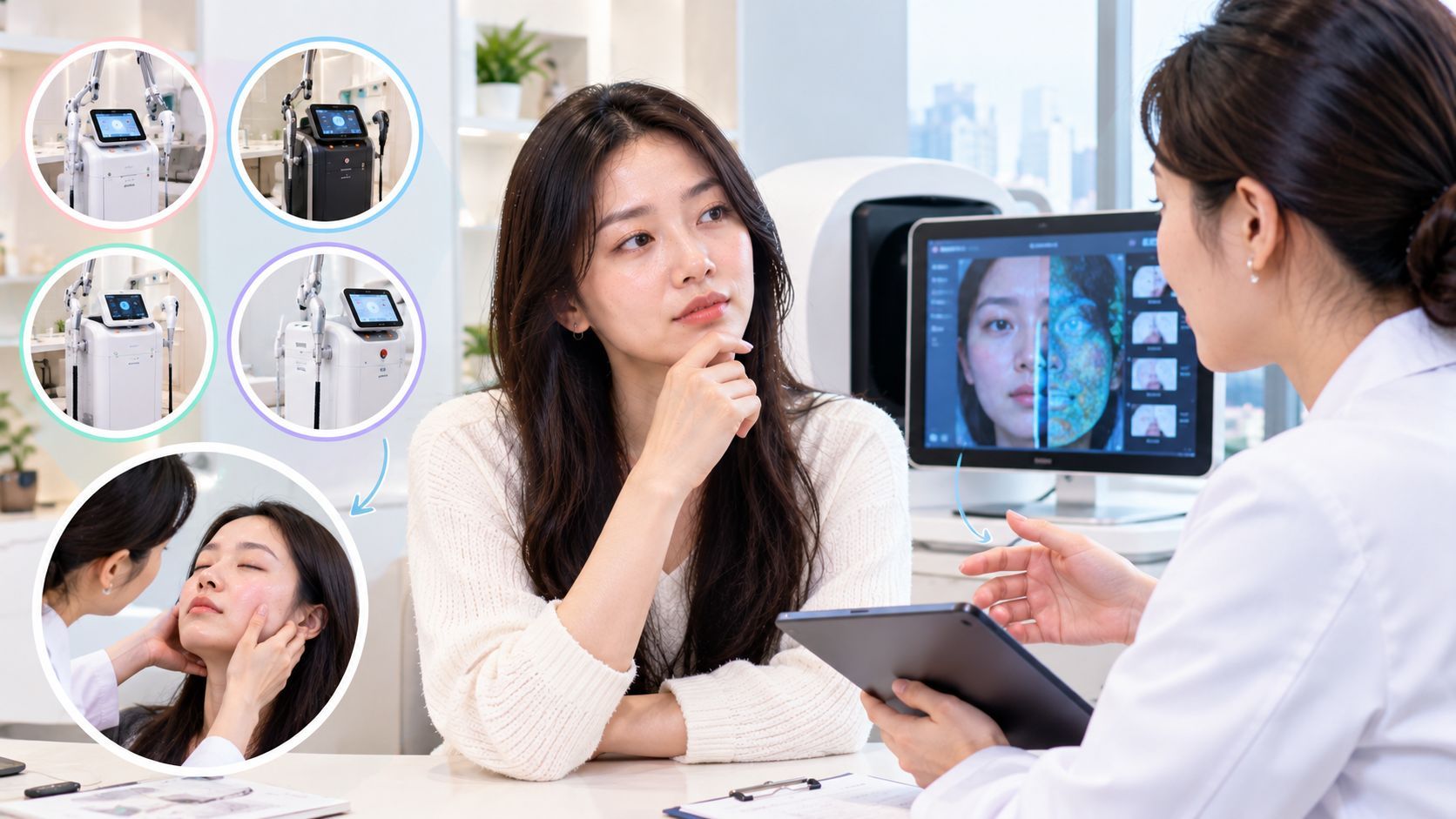
- Have a consultation before choosing the device.
- Ask which scar types are being treated.
- Ask whether laser alone is expected to be sufficient.
- Confirm the expected recovery period.
- Discuss your skin tone and history of pigmentation.
- Plan around flights, sun exposure, and outdoor activities.
- Ask how follow-up will be handled after returning home.
If you are only in Seoul for a few days, a treatment requiring substantial healing may need to be scheduled differently from a procedure with minimal downtime.
What Is a Realistic Goal for Acne-Scar Laser Treatment?
A realistic goal is usually visible improvement, not complete erasure.
Successful treatment may make scars:
- Shallower
- Softer
- Less sharply defined
- Less noticeable in normal lighting
- More blended with surrounding skin
- Less obvious when viewed from certain angles
However, the result may still show some residual scarring.
This is particularly important for deep, longstanding scars.
A dermatologist should explain what the chosen procedure is realistically capable of improving rather than promising complete removal.
Frequently Asked Questions
Can laser completely remove old acne scars?
Usually, no. Laser can significantly improve the appearance of some acne scars, but complete removal cannot be guaranteed, particularly for deep or structurally complex scars.
How many laser sessions do acne scars need?
There is no fixed number. Some people see noticeable improvement after one treatment, while others need multiple sessions or combinations of procedures.
Is CO₂ laser enough for deep acne scars?
Not necessarily. CO₂ laser can improve certain atrophic scars, but deep ice-pick, tethered rolling, or deep boxcar scars may require additional techniques.
Can laser remove rolling scars?
Laser can improve the surface texture of rolling scars, but it cannot necessarily release fibrous tethering beneath the skin. Subcision may be considered when tethering contributes significantly to the depression.
Can darker skin have laser treatment for acne scars?
Yes, in many cases, but the risk of post-inflammatory hyperpigmentation and other pigment changes needs to be considered when selecting the treatment and settings.
Is one aggressive acne-scar treatment enough?
One treatment can sometimes produce a visible difference, but it is unlikely to completely remove established acne scars. Treatment response depends heavily on scar type, depth, skin characteristics, and the technique used.
Conclusion
Laser treatment can be an important part of acne-scar management, but complete removal is not a realistic promise for established acne scars. The most appropriate approach depends on whether the scars are ice-pick, rolling, boxcar, or another type, as well as their depth and underlying structure.
For some people, fractional laser may provide meaningful resurfacing. Others may benefit more from RF microneedling, subcision, TCA CROSS, punch techniques, or a carefully staged combination.
The goal is generally to make scars less visible and the skin more even, rather than to guarantee perfectly scar-free skin.