Why Do My Acne Scars Look Worse Under Overhead Lighting?
If your acne scars look relatively mild in natural daylight but suddenly appear deeper, darker, or more uneven under overhead lighting, you are not necessarily imagining the difference. Lighting can dramatically change how skin texture appears.
Overhead lights create shadows inside depressions and along raised edges. This can make rolling scars, boxcar scars, enlarged pores, and other surface irregularities look much more noticeable.
That does not necessarily mean your acne scars have become worse. In many cases, the lighting is revealing texture that is less obvious under softer or more evenly distributed light.
Understanding this difference is important before deciding that you need a stronger laser or more aggressive acne-scar treatment.
Why Does Overhead Lighting Make Acne Scars Look Deeper?
Acne scars are three-dimensional changes in the skin. Even relatively shallow depressions can create shadows when light comes from directly above.
Under diffuse lighting, light reaches the face from multiple directions. This reduces strong shadows and can make the skin appear smoother.
Under a ceiling light, however, the light travels downward across the face. Depressed areas may receive less direct light while their edges remain illuminated.
The resulting contrast can make scars appear deeper than they do in other conditions.
The Same Scar Can Look Different in Different Lighting
You may notice your scars look:
- Mild in soft daylight
- More visible beside a bright window
- Deeper under a bathroom ceiling light
- More noticeable when photographed from above
- Less obvious when light comes from directly in front
- More pronounced when looking closely in a mirror
These differences do not necessarily indicate a change in the actual scar.
Which Acne Scars Are Most Noticeable Under Overhead Lighting?
Different scar structures react differently to directional lighting.
Rolling Acne Scars
Rolling scars create broad, shallow depressions and uneven transitions between raised and depressed areas.
Overhead lighting can emphasize these transitions by creating alternating areas of light and shadow.
If rolling scars are tethered underneath the skin, the shadows may make the depressions particularly obvious.
Boxcar Scars
Boxcar scars have relatively defined edges.
When light comes from above, the edges can cast shadows into the depression, making the scar appear sharper or deeper.
Shallow boxcar scars can therefore sometimes look surprisingly prominent under harsh lighting despite being less noticeable in softer conditions.
Ice-Pick Scars
Ice-pick scars are narrow and deep.
Because of their small openings and depth, they can create concentrated dark areas under directional lighting.
A close-up mirror inspection under strong overhead illumination can therefore make individual ice-pick scars appear particularly severe.
Does Overhead Lighting Mean Your Acne Scars Are Severe?
Not necessarily.
Lighting can exaggerate texture even when the underlying scars are relatively mild.
This is one reason it can be misleading to evaluate your skin only under a bathroom ceiling light or with a close-up phone camera.
A more useful assessment considers the scars under several conditions:
- Normal indoor lighting
- Diffuse daylight
- Front-facing light
- Different facial angles
- Relaxed facial expressions
- Normal conversational distance
A dermatologist can also examine the skin directly rather than relying only on photographs.
Why Do Acne Scars Look Worse in Photos?
Photography can exaggerate texture for several reasons.
Camera Position
A camera positioned above or below the face changes how shadows fall across depressions.
A close-up photograph can also magnify details that other people would not notice at normal conversational distance.
Directional Light
A bright light positioned above, beside, or behind you can create stronger contrast.
This can make shallow depressions appear significantly deeper.
Phone Processing
Modern smartphones automatically adjust exposure, contrast, sharpness, and other image characteristics.
These processing effects can make small differences in skin texture appear more pronounced than they are to the naked eye.
Very Close Inspection
When you hold a phone or mirror only a few centimeters from your face, you are viewing details from a distance at which other people normally do not see you.
This can create an unrealistic standard for evaluating treatment results.
Could Your Scars Actually Be Getting Worse?
Lighting alone does not mean that scars are worsening.
True changes in acne scars should be considered separately from changes in how they appear.
If you notice a persistent change in texture, new depressions, inflammation, new acne, or changes following a procedure, discuss those changes with a dermatologist.
A sudden increase in visibility under one particular light source is more likely to reflect the lighting conditions than a rapid structural change in the scar.
Should You Get Laser Because Your Scars Look Bad Under Overhead Lighting?
Not automatically.
A treatment decision should be based on the actual scar characteristics rather than the most unflattering lighting you can find.
Before choosing laser treatment, it is useful to determine:
- What type of acne scars you have
- Whether they are shallow or deep
- Whether rolling scars are tethered
- Whether pigmentation is contributing to their appearance
- Whether active acne is still present
- How noticeable the scars are under ordinary lighting
- How much improvement you realistically want
Surface Texture vs Structural Scarring
This distinction is particularly important.
If the main problem is superficial texture, fractional laser or RF microneedling may be considered.
If the problem is tethered rolling scars, resurfacing alone may not address the underlying cause.
If the scars are narrow and deep, such as ice-pick scars, targeted procedures may be more appropriate.
If pigmentation around the scars is the main concern, a scar-resurfacing procedure may not be the primary treatment.
Can Laser Make Acne Scars Look Better in Different Lighting?
It can, depending on the type of scar and treatment.
Improving the depth and edges of a depression can reduce the shadows that make the scar noticeable.
Fractional resurfacing may help blend certain textural irregularities. RF microneedling may also improve selected scars through collagen remodeling.
However, no treatment can guarantee that scars will look completely smooth under every lighting condition.
Even healthy, unscarred skin naturally has pores, contours, fine lines, and subtle variations in texture that become more visible under harsh directional light.
The realistic goal is usually improvement rather than completely eliminating every shadow or texture difference.
What If Your Acne Scars Look Fine Except Under Harsh Light?
This is an important situation to discuss before pursuing aggressive treatment.
If your scars are barely noticeable under ordinary lighting but appear dramatic under one particular ceiling light, you may want to consider how much the scars actually affect you in daily life.
That does not mean treatment is unnecessary.
It simply means the treatment goal should be based on your overall appearance and personal concerns rather than one extreme viewing condition.
A dermatologist can assess whether there is a meaningful structural problem that could reasonably benefit from treatment.
Should You Compare Acne-Scar Treatments Using Photos?
Before-and-after photographs can be useful, but they need to be interpreted carefully.
Ideally, photographs should use similar:
- Lighting
- Camera distance
- Camera angle
- Facial expression
- Focus
- Exposure
If the before photograph uses harsh overhead lighting and the after photograph uses soft frontal lighting, the apparent improvement may partly reflect the photography rather than the treatment itself.
The reverse is also true: a good treatment may appear less impressive if the follow-up photograph uses harsh directional lighting.
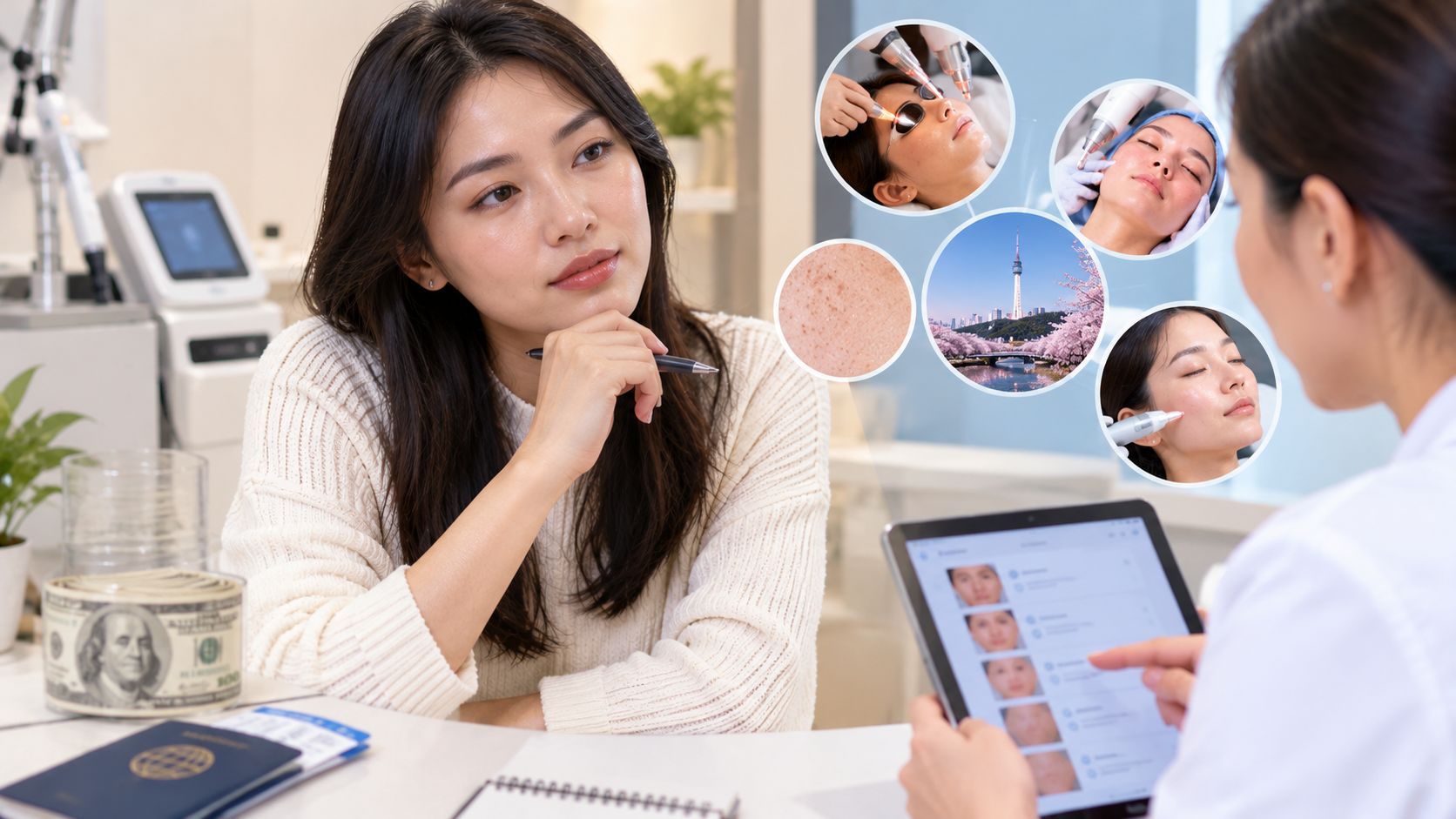
What Should International Patients Know Before Acne-Scar Treatment in Seoul?
If you are traveling to Seoul for acne-scar treatment, avoid choosing a procedure solely from photographs taken under unfavorable lighting.
During consultation, show the dermatologist photographs that represent how your skin normally looks rather than only highly magnified close-ups.
It is also useful to explain whether your concern is:
- Visible scars in normal conversation
- Texture under certain lighting
- Appearance in photographs
- Makeup application
- Skin texture at close range
- Unevenness that appears only from certain angles
This helps distinguish a treatment target from a lighting effect.
If you are planning an intensive laser procedure during a short Korea trip, also consider the expected redness, peeling, swelling, sun sensitivity, and follow-up requirements before scheduling treatment.
Can You Make Acne Scars Less Noticeable Without Aggressive Treatment?
Treatment does not always need to start with the most aggressive procedure.
Depending on the scar type, options can include:
- Fractional laser
- Non-ablative fractional laser
- RF microneedling
- Subcision for selected tethered scars
- TCA CROSS for selected ice-pick scars
- Punch techniques for certain deep scars
- Combination or staged treatment
The appropriate approach depends on the structure of the scars rather than how dramatic they look under a ceiling light.
How Should You Check Your Acne Scars at Home?
If you want a more realistic idea of your skin texture, avoid judging it only under direct overhead lighting.
Try checking your skin in:
- Soft natural daylight
- Normal indoor lighting
- Front-facing light
- A normal mirror-viewing distance
- Several facial angles
You can also take photographs from a normal distance rather than holding the camera extremely close to your face.
This does not replace professional assessment, but it can give you a more balanced understanding of how your skin actually appears.
Frequently Asked Questions
Why do my acne scars look worse under bathroom lights?
Bathroom ceiling lights are often relatively directional. They can create shadows inside depressions and along scar edges, making acne scars appear deeper and more noticeable.
Does harsh lighting mean my acne scars are severe?
No. Harsh lighting can exaggerate even relatively shallow scars. Severity should be assessed from the actual scar structure and appearance under normal conditions.
Why do my acne scars look better in natural light?
Diffuse natural light can reduce the contrast between raised and depressed areas of the skin, making texture appear more even.
Should I get laser if my scars only bother me under certain lighting?
Not necessarily. A dermatologist can assess whether the scars have structural characteristics that are likely to respond to treatment and whether treatment is appropriate for your goals.
Can laser make acne scars completely invisible?
Laser can improve the appearance of many acne scars, but complete removal or invisibility under every lighting condition cannot be guaranteed.
Are phone photos accurate for judging acne scars?
Not always. Camera distance, angle, lighting, exposure, and image processing can significantly change how skin texture appears.
Conclusion
Acne scars often look worse under overhead lighting because directional light creates shadows inside depressions and along uneven scar edges. This does not necessarily mean that your scars have become deeper or more severe.
Before choosing laser or another acne-scar procedure, evaluate your skin under ordinary lighting and have the actual scar structure assessed. Rolling, boxcar, and ice-pick scars can require different approaches, and stronger treatment is not automatically more appropriate.
For patients considering acne-scar treatment in Seoul, a detailed consultation can help determine whether the problem is primarily structural scarring, pigmentation, surface texture, or simply exaggerated by lighting.