Why Are My Acne Scars Still Visible After Several Laser Sessions?
Introduction
It can be frustrating to complete several laser treatments and still see acne scars when you look closely at your skin. However, persistent scars do not necessarily mean that the treatment failed.
Acne scars are structural changes in the skin, and different scar types respond differently to treatment. Fractional lasers can stimulate collagen remodeling and improve the appearance of depressed scars, but improvement is usually gradual and multiple sessions may be needed. The American Academy of Dermatology also emphasizes that acne-scar treatment should be individualized according to scar type, skin tone, and other patient factors.
If your scars are still visible after several sessions, the more useful question is whether the treatment is addressing the actual type and depth of your scars rather than simply whether you need more laser.
Why Can Acne Scars Still Be Visible After Laser?
Acne scars are structural, not just surface imperfections
Many depressed acne scars involve changes in the dermis and the collagen architecture beneath the skin.
Laser resurfacing can encourage remodeling and make these depressions less noticeable, but it does not necessarily recreate completely normal skin architecture.
As a result, successful treatment may mean that scars become shallower, softer, or less noticeable rather than disappearing completely.
The scar type may not match the treatment
This is one of the most important reasons for limited improvement.
Acne scars are commonly described as:
- Ice-pick scars
- Boxcar scars
- Rolling scars
- Mixed atrophic scars
These structures behave differently.
A treatment that improves overall texture may have limited ability to correct a narrow, deep ice-pick scar. Similarly, a rolling scar tethered to deeper tissue may need a treatment that releases the underlying attachment rather than relying only on surface resurfacing.
Could You Simply Need More Laser Sessions?
Sometimes, yes.
Collagen remodeling does not happen immediately after laser treatment. Depending on the procedure, the skin continues changing during the months following treatment.
Some people therefore need a series rather than a single procedure.
However, more sessions are not automatically the answer.
If several appropriately spaced treatments have produced little meaningful change, repeating exactly the same procedure without reassessing the scars may have diminishing value.
A recent systematic review of minimally invasive treatments for atrophic acne scars found substantial uncertainty and heterogeneity across studies and concluded that current evidence does not support a dependable universal treatment hierarchy.
Your Laser May Be Improving Texture Without Completely Removing the Scars
Laser treatment can produce changes that are subtle when viewed from one photograph or from a normal conversational distance.
You may notice:
- Smoother overall texture
- Softer scar edges
- Less visible shadows
- More even light reflection
- Gradual collagen remodeling
Yet individual depressions may remain visible under direct lighting or when you stretch the skin.
This is particularly common when the original scars are deep.
Comparing standardized photographs taken under the same lighting and angle can be more useful than relying only on memory.
Could Deep Acne Scars Need More Than Laser?
Rolling scars may have deeper tethering
Some rolling scars are attached to deeper tissue by fibrous bands.
Resurfacing the surface does not necessarily release those attachments. In selected cases, a dermatologist may consider procedures such as subcision to address the deeper component.
Ice-pick scars can be difficult to treat with resurfacing alone
Very narrow and deep scars may extend farther downward than a conventional resurfacing treatment can effectively remodel.
Depending on the individual scar, a dermatologist may consider focal techniques rather than treating the entire face more aggressively.
Boxcar scars vary in depth
Shallow boxcar scars may respond to resurfacing and collagen-remodeling procedures, while deeper scars may require a more individualized combination approach.
The important point is that “acne scars” is not one single condition.
Could the Laser Settings Have Been Too Conservative?
Possibly, but increasing the intensity is not automatically the solution.
Laser treatment involves a balance between tissue remodeling and unwanted inflammation.
Higher intensity can increase treatment effects, but it can also increase downtime and certain adverse effects. A 2026 systematic review comparing fractional CO₂ and erbium-based fractional lasers found that fractional CO₂ showed a favorable clinical-response signal in the included studies but was also associated with greater pain and longer downtime.
Therefore, the goal should not simply be to use the strongest available setting.
The appropriate parameters depend on the scar pattern, skin characteristics, previous response and acceptable recovery time.
Could Your Skin Type Affect the Treatment Plan?
Yes.
Skin tone and pigmentation history can influence the risk-benefit calculation for resurfacing.
If you are prone to post-inflammatory hyperpigmentation, aggressive resurfacing may create unwanted pigmentation that makes the skin look worse even if the underlying scar has improved.
This is one reason a clinician may choose a more conservative approach or consider alternatives such as RF microneedling.
A recent systematic review comparing needling-based treatments with ablative fractional lasers found that both approaches can improve acne scars. The review also found that needling-based treatments generally had shorter downtime, better tolerability, and fewer pigmentary adverse effects, while ablative fractional lasers often showed greater improvement in some comparisons.
These findings do not establish one universal treatment for everyone. They illustrate why treatment selection needs to consider both expected improvement and the patient's tolerance for downtime and pigmentation risk.
When Should You Consider Changing the Treatment?
If there has been almost no improvement
If you have completed several appropriately spaced sessions and cannot identify meaningful improvement in texture, scar depth, or overall appearance, it may be time for reassessment.
The first question should be whether the diagnosis and scar classification are correct.
If only certain scars remain
You may have improved substantially overall while a few deeper scars remain.
In that situation, treating the entire face repeatedly may not be the most logical approach.
A dermatologist may instead consider targeted treatment of the remaining scars.
If pigmentation is becoming a bigger problem
If each laser session leaves you with prolonged darkening or inflammation, the treatment strategy may need to change.
Treating scars more aggressively while repeatedly creating pigmentation can make the overall appearance more difficult to improve.
Could Combination Treatment Work Better?
Acne-scar treatment frequently involves more than one modality because different procedures address different components of a scar.
Depending on the scar type, a treatment plan may include combinations such as:
- Fractional laser
- RF microneedling
- Microneedling
- Subcision
- TCA CROSS
- Fillers for selected depressed scars
- Other focal scar procedures
The American Academy of Dermatology lists laser resurfacing, microneedling, radiofrequency, fillers and scar surgery among approaches that may be used for different acne-scar presentations.
Combination treatment should not mean doing everything at once. Procedures need to be selected according to the actual scar morphology and the patient's skin.
How Can You Tell Whether Your Laser Treatment Is Actually Working?
Use standardized photographs
Take photographs:
- Under the same lighting
- From the same distance
- At the same angle
- Without changing camera filters
- At comparable times after treatment
This can reveal gradual improvement that is difficult to notice day to day.
Look at more than pigmentation
Acne-scar improvement can involve changes in:
- Depth
- Shadowing
- Scar edges
- Skin texture
- Overall smoothness
A scar can become shallower without completely disappearing.
What Should You Ask Your Seoul Dermatology Clinic?
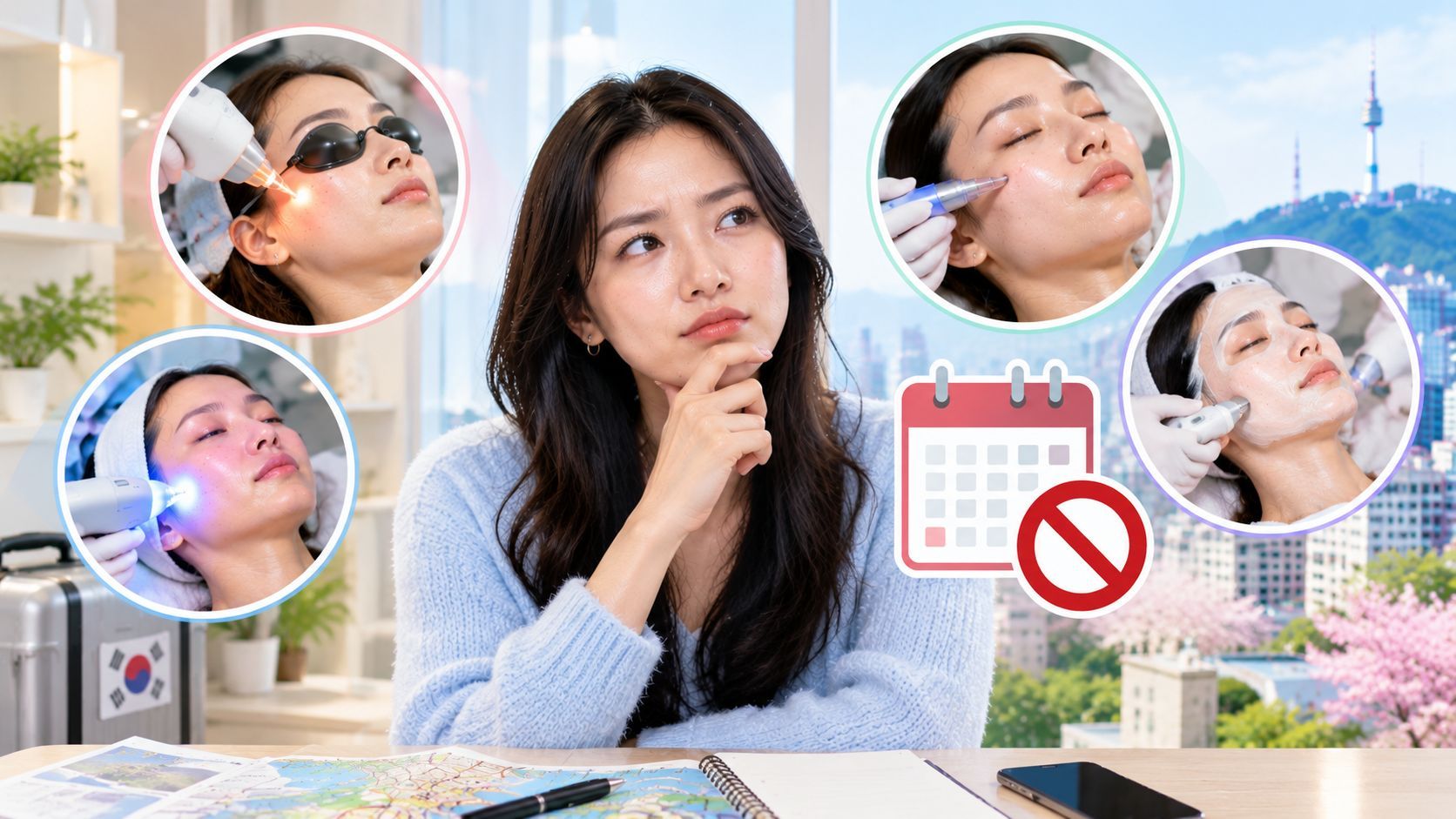
If you are traveling to Seoul specifically for acne-scar treatment, avoid choosing a clinic based only on the laser machine's name.
Ask:
- What type of acne scars do I have?
- Which scars are actually expected to respond to this laser?
- How much improvement is realistic?
- How many sessions are usually considered before reassessment?
- Would RF microneedling be an alternative?
- Do any of my scars require subcision or focal treatment?
- What is my pigmentation risk?
- What happens if the laser does not produce enough improvement?
If possible, bring photographs from before your previous treatments and the names of the devices and procedures you received.
This can help the dermatologist determine whether continuing the same strategy makes sense.
When Should You Stop and Get a Second Opinion?
A second dermatologic assessment can be useful when several sessions have produced little improvement, particularly if:
- Your scars were never formally classified
- The treatment plan has remained unchanged despite poor response
- You are developing repeated pigmentation
- You are experiencing prolonged inflammation
- You are being encouraged to increase treatment intensity without a clear explanation
The purpose of a second opinion is not necessarily to choose a different machine. It is to reassess the scar structure and treatment strategy.
Conclusion
Acne scars can remain visible after several laser sessions because they are structural, different scar types respond differently, some scars require deeper or more targeted treatment, and collagen remodeling takes time.
If you have seen some improvement but still have visible scars, that does not automatically mean the treatment failed. If you have seen little or no meaningful improvement after several sessions, however, repeating the same laser indefinitely may not be the most useful next step.
The key is to identify whether you have rolling, boxcar, ice-pick, or mixed scars and determine which component remains. Laser may be part of the solution, but some patients may need a different modality or a carefully planned combination approach.
For international patients coming to Seoul, a detailed scar assessment and individualized treatment plan are more informative than simply choosing the clinic with the most laser devices.
Frequently Asked Questions
Why are my acne scars still visible after three or four laser treatments?
Several possibilities exist: the scars may be deep, the treatment may be improving texture rather than eliminating individual depressions, the scar type may not be ideally suited to that laser, or additional treatment may be required. Reassessment is more useful than automatically adding sessions.
Can laser completely remove acne scars?
Usually, treatment aims to make scars less noticeable rather than guarantee complete removal. The amount of improvement depends heavily on scar type, depth, skin characteristics and treatment approach.
Should I switch from laser to RF microneedling?
It may be worth discussing if laser has produced insufficient improvement or if downtime and pigment risk are important concerns. Evidence suggests both ablative fractional lasers and needling-based approaches can improve acne scars, but their benefits and adverse-effect profiles differ.
Do deep acne scars need subcision?
Some rolling scars have deeper fibrous tethering and may benefit from a procedure designed to release those attachments. Whether subcision is appropriate requires an examination of the individual scars.
Is fractional CO₂ worth continuing if my scars have barely changed?
Not automatically. Fractional CO₂ can improve atrophic acne scars, but if several appropriately performed treatments have produced minimal change, the scar type and treatment strategy should be reassessed before continuing.
Can acne scars improve months after laser treatment?
Yes. Collagen remodeling continues after the procedure, so the final appearance should not necessarily be judged immediately after treatment. The appropriate evaluation point depends on the specific laser and treatment protocol.