Is Stronger Laser Always Better for Acne Scars?
Introduction
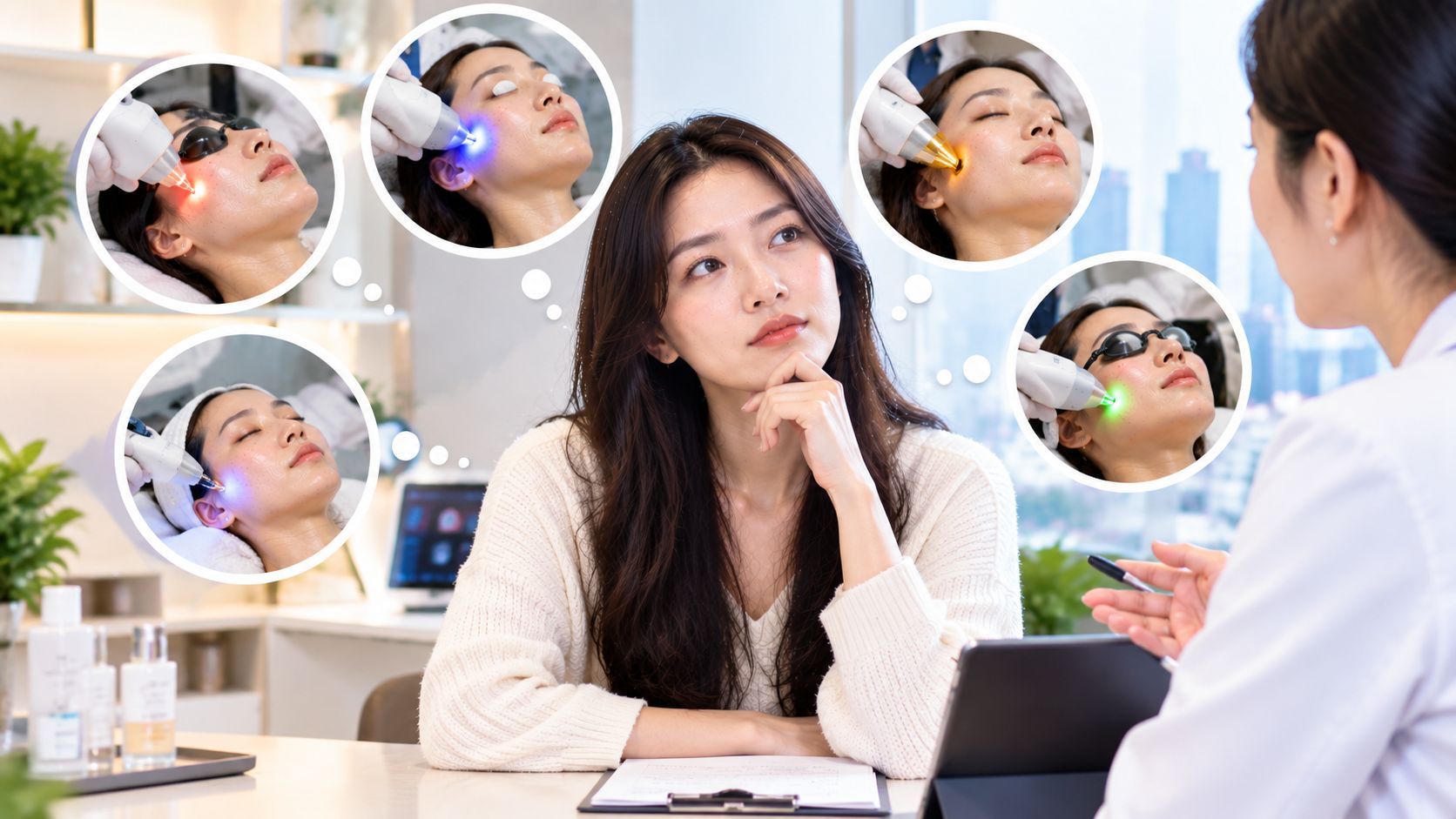
When people research fractional CO2 laser for acne scars, it is easy to assume that a stronger treatment must produce a better result. Higher energy, greater treatment density, deeper resurfacing, or more aggressive passes can sound more effective.
But acne-scar treatment does not work that simply. A stronger laser is not automatically a better laser treatment. The goal is to create enough controlled injury to stimulate remodeling while avoiding unnecessary inflammation, prolonged healing, pigmentation changes, and other complications.
Studies of fractional CO2 treatment in Asian patients have found that higher fluence or density can produce more adverse effects without necessarily producing greater improvement. One randomized split-face study found no significant efficacy difference between several CO2 settings, while higher fluence or density produced more adverse effects.
Is Stronger Laser Always Better for Acne Scars?
No. The most appropriate laser intensity depends on the scar type, skin characteristics, treatment area, previous treatments, pigmentation risk, and the clinician's treatment plan.
A moderately aggressive treatment performed in several carefully planned sessions can sometimes be more appropriate than one very aggressive session.
This is particularly important for patients with darker or pigment-prone skin. Fractional CO2 can improve atrophic acne scars, but studies have identified post-inflammatory hyperpigmentation and other adverse effects as important considerations in Asian skin.
Why More Powerful Laser Does Not Automatically Mean Better Results
Higher Energy Creates More Tissue Injury
Fractional ablative CO2 laser works by creating microscopic columns of controlled thermal injury in the skin. This stimulates wound healing and collagen remodeling while leaving untreated areas between the treatment columns.
Increasing treatment intensity can increase the amount of tissue affected. That may sometimes be appropriate, but it also increases the inflammatory burden.
The objective is therefore not simply to maximize energy. It is to find an intensity that provides meaningful remodeling while keeping the risk and recovery period acceptable.
More Treatment Density Can Also Increase Risk
Energy is only one part of the equation. Treatment density—the proportion of skin receiving treatment—also matters.
Research involving Asian acne-scar patients has found that higher density can increase pigmentation risk. In a study of non-ablative fractional resurfacing, reducing the total treatment density lowered PIH risk while maintaining clinical improvement through additional sessions.
This illustrates an important principle: more treatment in one session is not necessarily the only way to achieve more improvement.
More Downtime Does Not Mean More Collagen
A treatment that leaves the face red, swollen, crusted, or uncomfortable for longer is not automatically producing a superior result.
Downtime primarily reflects the amount of tissue injury and the individual's healing response. It should not be used as a measurement of treatment quality.
A treatment plan should instead consider:
- expected scar improvement
- risk of pigmentation
- skin type
- scar morphology
- recovery time
- number of sessions
- other procedures that may be more appropriate
Acne Scar Type Matters More Than Simply Choosing the Strongest Laser
Acne scars are not one single condition. Dermatologists commonly distinguish between ice-pick, rolling, and boxcar scars, and different scar structures can require different approaches.
Rolling Scars
Rolling scars are broad, shallow depressions that can create an uneven or wavy appearance.
Some are associated with fibrous attachments pulling the skin downward. In those situations, resurfacing alone may not address the underlying tethering.
A dermatologist may consider subcision or another scar-release technique rather than simply increasing laser intensity.
Boxcar Scars
Boxcar scars have relatively defined edges and can vary considerably in depth.
Fractional resurfacing may be useful for some boxcar scars, but the appropriate intensity depends on their depth, location, skin characteristics, and whether other scar treatments are necessary.
More aggressive treatment is not automatically appropriate for every boxcar scar.
Ice-Pick Scars
Ice-pick scars are narrow but deep. Because their structure is different from broad rolling scars, simply increasing the strength of a full-face fractional laser may not be the most targeted strategy.
Some patients may be evaluated for treatments such as TCA CROSS or other focal approaches.
This is why a treatment plan based only on “the strongest CO2 setting available” can overlook the actual anatomy of the scars.
What Does Research Say About Lower Versus Higher CO2 Settings?
Research does not support a simple rule that higher settings always produce superior acne-scar results.
In an Asian split-face randomized study, different fractional CO2 fluences and densities were compared. The investigators found no significant difference in efficacy between the tested settings, while adverse effects were more evident with higher fluence or density.
Another review focusing on pigmented atrophic acne scars in skin of color specifically discussed using controlled treatment parameters, including lower fluence and density, with repeated treatments when appropriate to minimize complications.
This does not mean that low-intensity treatment is always better. It means that intensity needs to be individualized rather than maximized.
How Skin Type Changes the Decision
Why Pigmentation Risk Matters
Post-inflammatory hyperpigmentation can be an important concern after laser resurfacing, particularly in darker or pigment-prone skin.
A review of energy-based devices for acne scars in skin of color found that PIH risk is influenced by factors including skin phototype, device, fluence, and especially treatment density.
Some clinical studies in Asian patients have reported substantial rates of temporary pigmentation after fractional CO2 treatment, although rates vary greatly according to treatment protocol, patient characteristics, and study design.
Therefore, someone who has a strong tendency toward PIH may need a different strategy from someone with lower pigment risk.
A More Aggressive Treatment May Sometimes Be Reasonable
This does not mean aggressive resurfacing should never be used.
A dermatologist may recommend stronger fractional resurfacing when the expected benefit justifies the additional downtime and risk. The decision can depend on:
- severity of atrophic scarring
- scar depth
- skin phototype
- history of PIH
- recent sun exposure or tanning
- active acne or inflammation
- previous procedures
- desired treatment speed
- ability to follow aftercare instructions
The important distinction is between appropriately intensive treatment and simply choosing the strongest available setting.
Can Several Moderate Treatments Be Better Than One Aggressive Treatment?
Sometimes, yes.
Acne-scar remodeling is often a process rather than a one-session correction. Some clinical research has found improvement across multiple fractional CO2 sessions, and studies in Asian patients have explored repeated treatments as a way to balance improvement with complications.
A staged plan can allow the clinician to evaluate how the skin responds before deciding whether additional treatment is appropriate.
This can be particularly relevant when pigmentation risk is a major concern.
However, multiple moderate treatments are not automatically superior either. The correct number and intensity of sessions depend on the individual scar pattern and treatment modality.
What About RF Microneedling or Other Treatments?
If the main concern is avoiding extensive ablative resurfacing, other options may be considered.
RF microneedling delivers controlled radiofrequency energy through microneedles and may be useful for selected acne scars. Non-ablative fractional lasers are another option, particularly when reducing downtime and pigment risk is important.
Evidence suggests that different modalities have different trade-offs rather than one universally superior approach. A recent meta-analysis found fractional CO2 to have favorable efficacy in some comparisons but also a higher PIH risk than standard microneedling, reinforcing the importance of patient and treatment selection.
How a Doctor Should Decide Laser Intensity
A thoughtful consultation should begin with the scars—not the machine.
The clinician should assess:
- Scar morphology — rolling, boxcar, ice-pick, or mixed.
- Scar depth — superficial texture problems may require a different approach from deep depressions.
- Skin characteristics — including pigmentation tendency and previous PIH.
- Active acne — ongoing inflammation may need to be controlled first.
- Previous treatments — including lasers, microneedling, subcision, peels, or injections.
- Treatment goals — subtle improvement, major texture improvement, or preparation for an event.
- Recovery tolerance — especially for international patients with limited time in Seoul.
The laser parameters should then be selected around those factors.
What to Ask a Seoul Clinic Before Choosing Stronger CO2
If you are considering fractional CO2 laser in Seoul, ask questions such as:
- What type of acne scars do I have?
- Which scars are you treating with CO2?
- Why do you recommend this treatment intensity for my skin?
- Would a lower-density or staged treatment be more appropriate?
- What is my individual PIH risk?
- Do I need subcision or another procedure before resurfacing?
- How much downtime should I expect?
- What happens if my skin develops prolonged pigmentation?
- Will I need more than one session?
- What follow-up is available if I am returning home after treatment?
These questions can reveal whether the clinic is developing a personalized treatment plan rather than simply offering the most powerful setting.
Stronger vs More Conservative Acne-Scar Treatment
ApproachPotential advantageMain considerationLower/moderate intensityLess tissue injury and potentially easier recoveryMay require additional sessionsHigher intensityMore substantial resurfacing in selected patientsMore downtime and potentially greater complication riskStaged treatmentsAllows gradual remodeling and assessmentRequires more visitsRF microneedlingCan provide dermal remodeling with different recovery characteristicsMay not address every scar type equallyTargeted scar treatmentAddresses specific scar anatomyOften requires combination planning
The right choice depends on the patient's skin and scar characteristics rather than the treatment being labeled “stronger.”
Conclusion
Stronger laser is not always better for acne scars. Higher energy or density can increase tissue injury and downtime without necessarily producing proportionally better scar improvement.
Acne-scar treatment works best when the intensity, modality, and number of sessions are matched to the scar type and the patient's skin characteristics. This is especially important for people prone to post-inflammatory hyperpigmentation.
If you are considering fractional CO2 in Seoul, focus less on finding the clinic that offers the strongest laser and more on whether the doctor can explain why a particular treatment intensity is appropriate for your scars, skin, and recovery goals.
FAQs
Is a stronger CO2 laser always better for acne scars?
No. Higher energy or density can increase tissue injury and complications without guaranteeing better scar improvement. Research in Asian patients has found settings with greater energy or density can produce more adverse effects without a significant efficacy advantage.
Does higher laser energy mean fewer acne-scar sessions?
Not necessarily. Acne scars often require a series of treatments, and treatment planning can prioritize controlled remodeling over maximum intensity in a single session.
Can aggressive CO2 laser make acne scars worse?
Significant complications are uncommon when treatment is appropriately selected, but excessive or poorly selected treatment can increase the risk of prolonged inflammation, pigmentation changes, burns, scarring, or other adverse effects. Risk depends on the patient and treatment parameters.
Is aggressive CO2 safe for darker skin?
Fractional CO2 can be used in darker skin, but pigment risk requires careful consideration. Skin phototype, fluence, density, device, and individual history can all affect PIH risk.
Would subcision be better than stronger laser for deep rolling scars?
It may be appropriate when rolling scars are tethered beneath the skin. A dermatologist needs to determine whether tethering is present; simply increasing laser intensity does not release every type of scar.
Should I choose a Seoul clinic based on how powerful its CO2 laser is?
The machine's maximum power is not a useful standalone measure of treatment quality. Consider whether the clinic provides an individualized scar assessment, explains its treatment parameters, discusses pigmentation and downtime, and offers an appropriate overall treatment plan.