Shurink vs Ultherapy: Why Is There Such a Big Price Difference?
Introduction
Shurink and Ultherapy are both focused-ultrasound treatments used for non-surgical skin tightening and lifting, but their prices in Seoul can be dramatically different. This can make it difficult for international patients to understand whether they are paying for a fundamentally different treatment or simply for a different device, treatment protocol, and clinical setup.
The price difference is real, but price alone does not tell you how much lifting you will receive. Shurink and newer Shurink Universe/Ultraformer MPT systems have multiple cartridges and treatment depths, while Ultherapy uses microfocused ultrasound with real-time visualization. The number of shots, treatment depth, treatment area, device model, and provider's treatment plan can all affect the final cost.
The Short Answer: The Price Difference Is About More Than the Machine
Shurink is a Korean HIFU platform associated with Classys, while Ultherapy is a microfocused ultrasound system from Ulthera/Merz. Both can deliver focused ultrasound energy into selected tissue layers, but their systems and treatment approaches differ. Classys documentation for Ultraformer MPT, marketed as Shurink Universe in Korea, lists cartridges for depths including 1.5 mm, 2.0 mm, 3.0 mm, and 4.5 mm.
Ultherapy uses DeepSEE visualization to see tissue during treatment and offers treatment depths of approximately 1.5, 3.0, and 4.5 mm.
So the large price gap does not simply mean that Shurink is a weak version of Ultherapy. At the same time, the two treatments should not be treated as completely interchangeable.
What Is Shurink?
Shurink is a Korean high-intensity focused ultrasound treatment used for non-surgical lifting and tightening.
The newer Shurink Universe/Ultraformer MPT platform can use different cartridges to target different tissue depths. Classys documentation lists 1.5-mm, 2.0-mm, 3.0-mm, and 4.5-mm options, allowing treatment to be adapted to different facial areas.
What Shurink Is Designed to Do
Depending on the protocol, focused ultrasound can be used to address:
- Mild skin laxity
- Early jawline changes
- Lower-face firmness
- Submental laxity
- Some eyebrow or upper-face lifting concerns
- General skin tightening
The treatment creates focused thermal effects within selected tissue layers rather than removing the surface of the skin.
What Is Ultherapy?
Ultherapy uses microfocused ultrasound with real-time visualization.
Its DeepSEE transducers allow the clinician to visualize tissue and select treatment depths of approximately 1.5, 3.0, or 4.5 mm. The 4.5-mm depth can reach the SMAS/platysma region in appropriate treatment areas.
The manufacturer describes the treatment as creating focused thermal coagulation points that stimulate a wound-healing and collagen-remodeling response.
Why Visualization Matters
One of the major distinctions is that Ultherapy's system is designed to provide imaging during treatment.
The clinician can scan the treatment area and see the tissue structure before delivering energy. The system's instructions for use show the imaging interface and treatment depths, including 1.5, 3.0, and 4.5 mm.
This does not mean that every Ultherapy treatment will produce a better visible result than every Shurink treatment. It means that real-time visualization is a meaningful technological difference between the systems.
Shurink vs Ultherapy: Main Differences
FactorShurink / Shurink UniverseUltherapyTechnologyHIFU / focused ultrasoundMicrofocused ultrasoundOriginKorean platformUlthera/Merz platformCommon depths1.5, 2.0, 3.0, 4.5 mm depending on cartridge1.5, 3.0, 4.5 mmReal-time tissue visualizationNot equivalent to Ultherapy's DeepSEE systemYesTreatment customizationCartridge and protocol dependentDepth and imaging-guided treatmentNon-invasiveYesYesSkin tighteningYesYesPrice in SeoulOften substantially lowerUsually substantially higherClinical historyNewer platformLonger-established platformDoes price guarantee better results?NoNo
Why Can Shurink Be So Much Cheaper?
There are several reasons.
1. Device and Consumable Economics
Different manufacturers have different equipment, cartridge, maintenance, and operating costs. Those expenses can influence clinic pricing.
2. Competition in the Korean Market
Shurink is widely offered in Korea, and clinics may compete heavily on price. Current Seoul clinic price lists show Shurink treatments advertised at substantially lower prices than Ultherapy treatments, although prices vary considerably by clinic and protocol.
3. Shot Count
A surprisingly important factor is the number of shots.
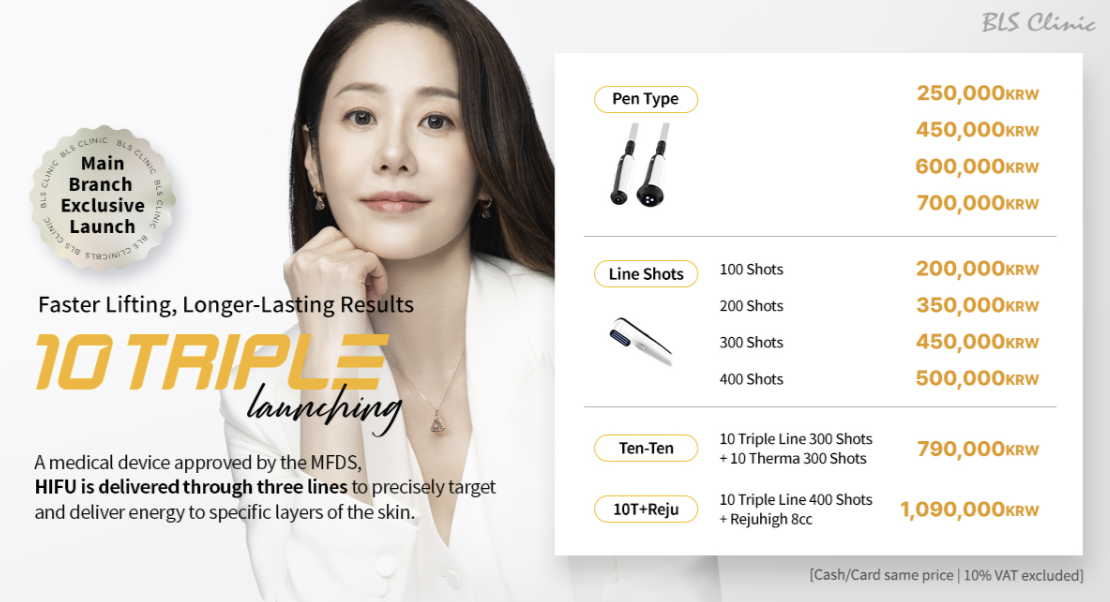
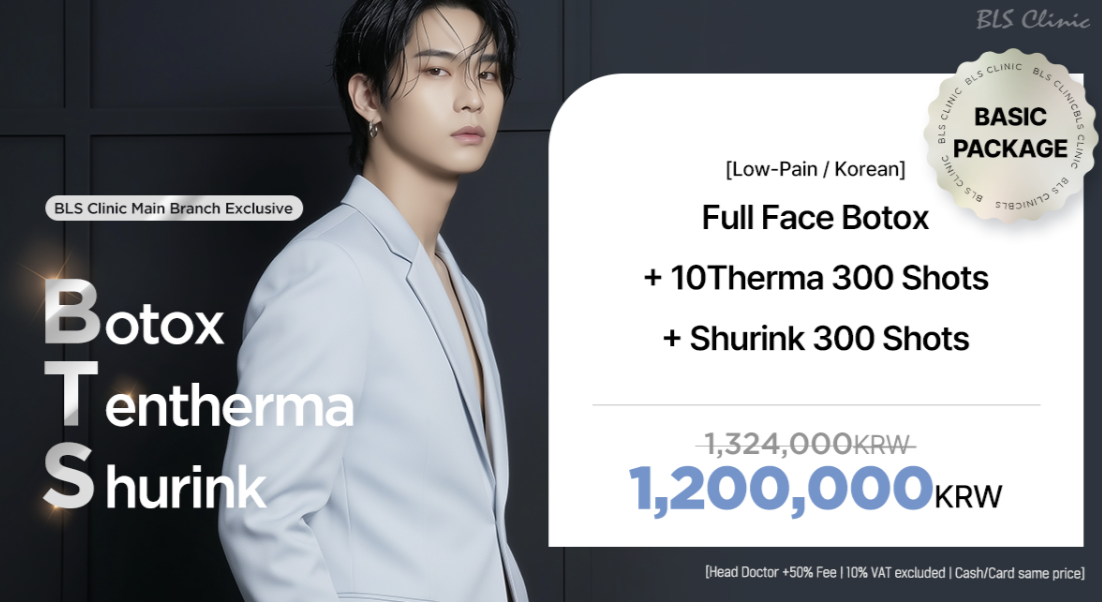
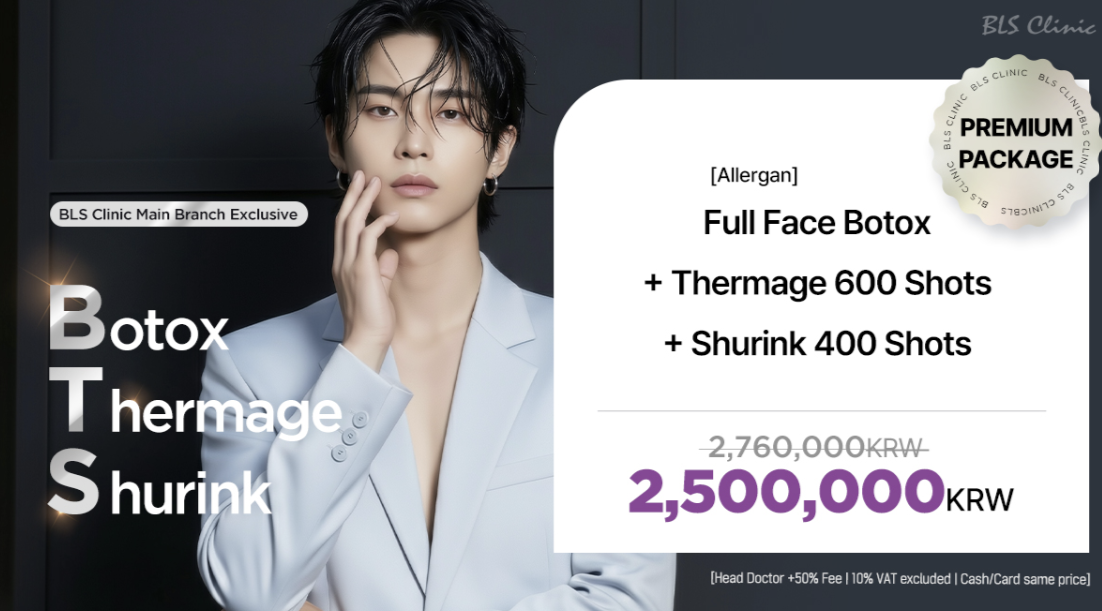
A promotional price for 100 or 300 shots should not automatically be compared with a full-face Ultherapy treatment using a different number of lines.
Current Seoul listings demonstrate how dramatically prices can change according to shot count and treatment area.
4. Treatment Area
Treating only the jawline is very different from treating:
- Full face
- Lower face
- Jawline
- Double chin
- Neck
- Face plus neck
A cheaper treatment may simply cover a smaller area.
5. Clinic Pricing Strategy
Clinics can set different prices based on location, staffing, consultation, promotions, practitioner experience, and other operating costs.
Therefore, comparing two advertised prices without comparing the actual treatment protocol can be misleading.
Does a Higher Ultherapy Price Mean a Stronger Lift?
Not necessarily.
Ultherapy has specific technological features, particularly real-time visualization and established multi-depth treatment options.
However, the final aesthetic outcome also depends on:
- Your degree of laxity
- Facial anatomy
- Treatment area
- Number of lines
- Treatment depth
- Energy settings
- Treatment mapping
- Provider technique
- Your individual response
Paying more for the device does not guarantee a proportionally larger improvement.
Can Shurink Reach the Same Depth as Ultherapy?
In terms of nominal treatment depth, some Shurink Universe/Ultraformer MPT cartridges reach 4.5 mm, while Ultherapy also has a 4.5-mm transducer. Classys lists 1.5-, 2.0-, 3.0-, and 4.5-mm cartridges for Ultraformer MPT.
However, depth alone does not make two treatments identical.
How the energy is delivered, how the treatment is mapped, how tissue is visualized, the exact cartridge, energy parameters, line spacing, and operator technique can all differ.
This is why saying “both reach 4.5 mm, so they are exactly the same” is an oversimplification.
Is Shurink Good for Mild Sagging?
It may be considered for appropriate patients with early or mild laxity.
Current Seoul clinic information commonly positions Shurink as a non-surgical lifting option for facial areas including the cheeks, jawline, double chin, and neck.
But the treatment should match the degree of laxity.
If the main problem is severe skin excess or substantial structural sagging, neither Shurink nor Ultherapy should be expected to reproduce the degree of change produced by surgery.
What If I Have a Thin Face?
This is an important consideration with any energy-based facial tightening treatment.
A thin face does not automatically rule out HIFU. However, treatment planning should consider existing facial volume and the exact areas being treated.
Ask the clinician:
“Which layers are you treating, and which areas will you avoid because I want to preserve facial volume?”
The goal should not simply be to maximize the number of shots or use the deepest cartridge everywhere.
What About Pain and Downtime?
Both treatments are non-invasive, but focused ultrasound can produce sensations of heat, pressure, tingling, or brief discomfort during treatment.
Temporary redness, swelling, tenderness, or sensitivity can occur afterward.
The actual experience depends on the treatment protocol, treatment area, energy level, and individual sensitivity.
If you are traveling to Seoul, consider your itinerary carefully. Even when downtime is limited, scheduling a treatment immediately before an important event may not be ideal if you do not know how your skin will respond.
How Many Shots Should I Get?
There is no universal number that every face needs.
A treatment advertised as “300 shots” should not automatically be considered equivalent to another clinic's 300-shot treatment.
Ask:
- What areas do the shots cover?
- Which depths are being used?
- Are all shots going to the same depth?
- How are the shots distributed across my face?
- Is the treatment designed for maintenance or correction?
Shot count is useful information, but it is not a complete measure of treatment quality.
What Should You Compare When Looking at Seoul Prices?
Before choosing a clinic, create a simple comparison:
QuestionClinic AClinic BExact deviceAskAskDevice modelAskAskNumber of shotsAskAskTreatment areaAskAskDepths usedAskAskDoctor performs treatment?AskAskReal-time imaging available?AskAskConsultation included?AskAskVAT included?AskAskAftercare included?AskAsk
This can reveal why two treatments advertised as “HIFU lifting” have very different prices.
Questions to Ask a Seoul Clinic Before Booking
If you are an international patient, ask these questions before paying a deposit:
About the Device
“Is this Shurink, Shurink Universe, or another HIFU device?”
About the Dose
“How many shots will I receive?”
About Depth
“Which cartridges or treatment depths will you use?”
About Treatment Mapping
“Which areas will you treat and which areas will you avoid?”
About the Provider
“Who will perform the treatment?”
About Pricing
“Does the quoted price include VAT, consultation, and all treatment charges?”
These questions are particularly useful when comparing a very inexpensive promotional treatment with a much more expensive branded treatment.
So, Why Is There Such a Big Price Difference?
The difference can come from device technology, visualization, treatment protocol, shot count, treatment area, consumables, clinic costs, practitioner factors, and pricing strategy.
Shurink Universe can use multiple treatment depths, including 4.5 mm, so it should not be dismissed simply because it costs less.
Ultherapy's major distinction is its real-time tissue visualization and established microfocused ultrasound platform, with treatment at 1.5, 3.0, and 4.5 mm.
Therefore, the price difference should be understood as a difference in technology and treatment package, not automatically as a direct measure of how much your face will improve.
Conclusion
Shurink and Ultherapy are both focused-ultrasound lifting treatments, but the large price difference has several explanations and does not by itself tell you which treatment is appropriate for your face.
Shurink Universe/Ultraformer MPT offers multiple cartridges and treatment depths, while Ultherapy provides real-time visualization during treatment and an established multi-depth microfocused ultrasound platform.
If you are considering treatment in Seoul, compare the exact device, model, shot count, treatment depth, treatment area, provider, and treatment plan rather than comparing headline prices alone.
FAQs
Why is Shurink cheaper than Ultherapy?
Pricing can differ because of equipment and consumable costs, market competition, clinic pricing, treatment protocols, shot count, and treatment area. A lower price does not by itself establish that the treatment is ineffective.
Is Shurink the same as Ultherapy?
No. They are different systems, although both use focused ultrasound. Shurink Universe/Ultraformer MPT offers multiple treatment depths, while Ultherapy includes real-time tissue visualization through its DeepSEE system.
Does Shurink reach 4.5 mm like Ultherapy?
Yes. Classys documentation for Ultraformer MPT lists a 4.5-mm cartridge in addition to shallower options. Ultherapy also offers a 4.5-mm treatment depth.
Does more HIFU shots mean a better result?
Not necessarily. Shot count needs to be considered alongside treatment area, depth, energy, spacing, facial anatomy, and treatment plan.
Is Ultherapy worth the higher price?
That depends on the individual's treatment goals and anatomy. Ultherapy's real-time visualization is a specific technological feature, but a higher price does not guarantee a proportionally better result for every patient.
Can I get Shurink during a short Seoul trip?
Potentially, depending on your medical suitability and itinerary. However, you should schedule a consultation first and leave enough time for any temporary redness, swelling, tenderness, or other treatment reactions.